Speed limits, desert roads, and the permission to linger
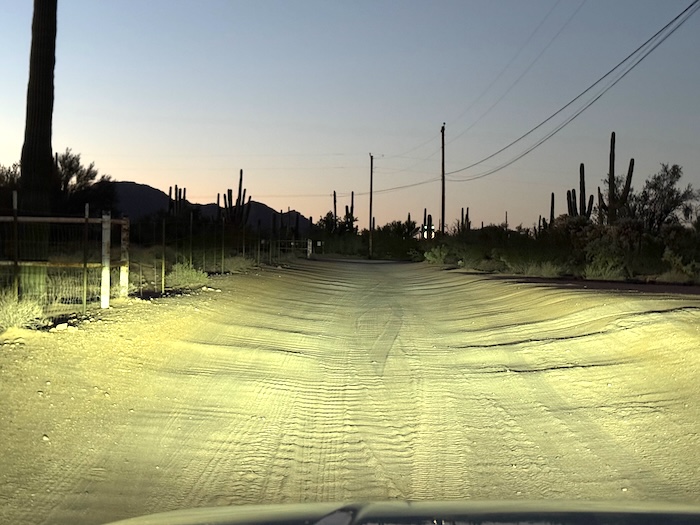
Out here in Picture Rocks, the roads teach patience.
Every drive starts with a choice: dirt or paved, bumps or smooth, thirty miles per hour or something slower. On West Rudasill, the posted limit is twenty-five—though it feels like there should be more. The road opens wide, the desert stretches out forever, and still the sign insists: 25.
Locals will tell you it’s not for the tourists or the traffic—it’s for the people who live here. For the kids walking a dog, the neighbor pulling out of a gravel driveway, the one who waves from behind a cloud of dust. The sign isn’t a rule so much as a reminder: someone lives here. Someone’s watching.
A mile later, it shifts to thirty. Then, eventually, forty.
It’s funny how the landscape decides the pace—closer houses mean slower speed; open spaces invite acceleration. Even the asphalt seems to change personality depending on who lives beside it.
On the dirt roads, though, there are no posted limits. The rain carves tiny ribs across the surface, turning every stretch into a washboard. You learn quickly that slow isn’t always safe. At fifteen miles an hour, the truck rattles like a shopping cart. At thirty, it suddenly glides. Too slow, and you feel every bump. Too fast, and you lose control. Somewhere between the two, the shocks do their work, and the ride becomes bearable.
There’s a strange poetry in that: sometimes speeding up is what steadies you.
I think about that when I remember our family’s long tradition of leaving early.
Every Fourth of July, we’d start the slow exit from the park right as the fireworks started to wind down. We’d tell the kids, “We’ll see them from the car.” We’d roll down the windows, crane our necks, try to catch the finale between streetlights and treetops—all so we could “beat the traffic.”
But of course, we never really did.
We just joined a different kind of crowd—everyone else trying to escape the same moment.
What we missed wasn’t the fireworks. It was the permission to stay—to linger through the noise and smoke, to let wonder finish its sentence before moving on.
And yet, we do it everywhere.
At concerts, plays, church services, even dinners with friends—we start packing up before the ending arrives. We’re halfway out the door of our own lives, planning our escape from now.
Maybe that’s why the desert feels like correction.
It won’t let you rush. The roads resist. The curves around Picture Rocks demand attention, the washboard hum keeps you grounded in the moment. Out here, hurry feels foreign, almost impolite.
Driving through this place, you start to wonder: what if speed limits aren’t about safety so much as sanity? What if they’re not meant to restrain us but to rescue us from our own momentum?
Every road out here carries its own pace.
And maybe that’s the invitation—to notice the road you’re on and match it, not fight it.