On Twin Peaks Road and other long projects that teach us how to wait well
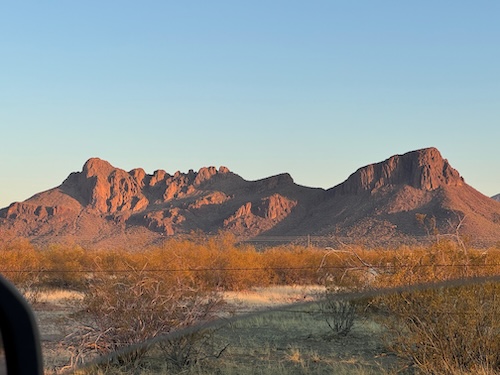
The road between Casa Saguaro and Starbucks was never finished. Twin Peaks Road—connecting Sandario to Silverbell through a new stretch of desert housing and a narrow pass between hills—was being expanded.
Every week, the cones shifted just enough to make you wonder if progress was being made or if they were simply rehearsing the idea of progress. By now, I’d learned to slow down without complaint—windows up, not tailgating the car in front of me, playlist on low, the desert wind kicking up the caution flags.
If I left before six, I’d catch the crew gathering along the new lanes. They’d form a loose circle in the pink light, boots dusted from yesterday, hard hats tucked under their arms. The foreman would speak—briefly, clearly—and then everyone peeled off to their stations.
No ceremony. No lengthy kickoff meeting.
Just a few words, a nod, and work.
There was something quietly holy about that circle.
Focus without spectacle. Commitment without applause.
⸻
And I would see that same thing again, a month or so later, hundreds of miles away.
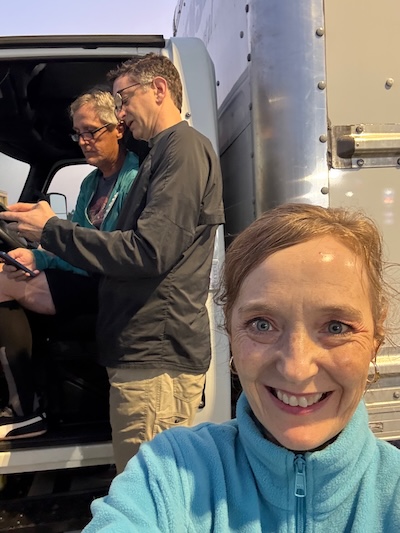
I was on I-57, driving one of two twenty-six-foot trucks, helping Tim and Jennifer move from South Carolina to Ames, Iowa. The morning was long and flat, the kind that erases your sense of speed until a flash of orange barrels brings you back to yourself.
Traffic slowed to a crawl. Trucks were told to stay left. Everyone else merged right. We idled together through the heat shimmer, inch by inch toward the work zone.
When I finally reached the heart of it, I saw a foreman unfold a piece of paper handed to him by a man in khakis—a civil engineer, maybe. They were working on the water system—pipes stacked along the shoulder, heavy equipment idling nearby. The foreman studied the plans, nodded once, and waved the backhoe forward. Dust rose, sunlight caught on rebar, and for a few seconds, the whole scene looked choreographed.
It struck me then: everything solid takes time.
Whether it’s a road, a deck, or a life, the work always outlasts the schedule.
⸻
I’ve built two decks, each time imagining it would take a weekend.
Felt like weeks.
Boards weren’t level, screws stripped, plans stretched.
But the slowness changed something in me.
There’s a stage in every project when progress flattens. You’re still showing up, but the payoff hides. It’s the plateau—the stretch where motivation dries up and patience starts doing the heavy lifting.
Someone once told me it takes fifteen to eighteen weeks to learn a new skill—to go from curiosity to competence. I’ve come to believe that’s true of almost everything worth keeping. The real work isn’t speed; it’s return.
⸻
Building anything—habits, furniture, writing—depends on repetition and recalibration. You do the day’s work, assess what’s done, and begin again tomorrow.
That’s what I admired about the Twin Peaks crew. They started each morning with that small, intentional circle. “Here’s the focus. Let’s go.” And then they went—no lingering, no overexplaining. The day’s practice began before the sun had fully risen.
Maybe that’s what persistence looks like: a series of small, faithful beginnings.
⸻
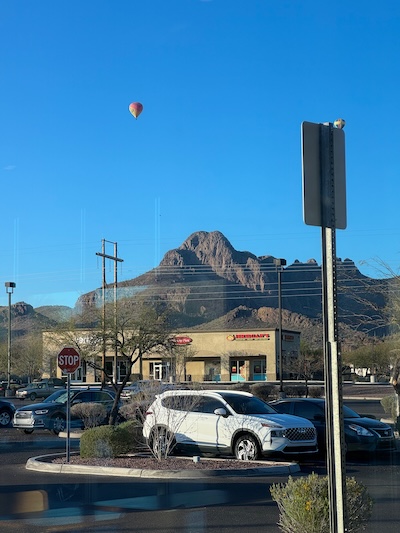
By the time I left Starbucks later in the day, the cones had shifted again, the line of progress moved a few feet forward.
No one watching would call it finished.
But something had changed.
And maybe that’s enough.
Because the truth is, none of us are building at the speed we imagined.
But if we keep showing up—checking the plans, laying the next board, grading the next inch—we’re already becoming builders of our own long roads.