
On leaving Casa Saguaro, tending to the ordinary work of departure, and learning how presence lingers even as we go
We have two weeks left at Casa Saguaro, though it hardly feels that long. Jan will visit this weekend, then we’ll fly east for Jen and Nathan’s graduation, and after that the long drive back to Indiana begins. It all feels both sudden and slow, as if time itself is stretching between lists.
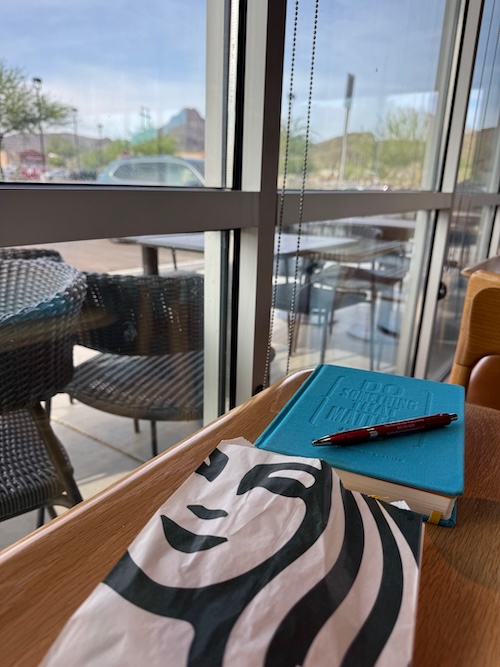
Today is our thirty-fifth anniversary. Lori is at the tiny house finishing paint along the trim, and I’m at Starbucks six miles away, doing what I always do—writing, watching people. A group nearby, dressed for something formal, shares quiet laughter before piling into a white Wagoneer. In the corner, an older man tells a younger one he’ll “walk through the fire with him.” I half-listen, half-wonder if he means it.
Meanwhile our own fire is ordinary: the small, steady kind that lives inside tasks. The to-do list hums—paint the front door, fix the back-door lock, box what goes north, shut off what stays behind, secure the things that might fly away in a desert gust. Each check mark feels like both progress and rehearsal.
It’s strange how endings echo beginnings. We make plans, rearrange furniture, measure the weight of what to keep. We tell ourselves we’re getting ready, when what we’re really doing is holding on. Maybe that’s what leaving teaches us: the difference between readiness and presence.
The desert never tells you it’s almost time to go.
You just start noticing small things—the paint chipped near the entryway, the squeak in the sliding door, the sag of a curtain rod that’s been slightly off since February. The kind of things you’d ignored when you first arrived, because you were busy arriving.
Now you’re busy leaving.
The mornings are slower, the to-do lists stranger. The house smells like cleaner and moving bins. I keep finding little piles of screws and tape, ghost traces of projects I swore I’d finish “before we left.”
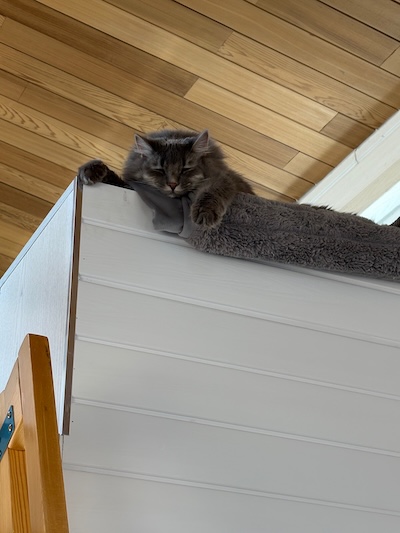
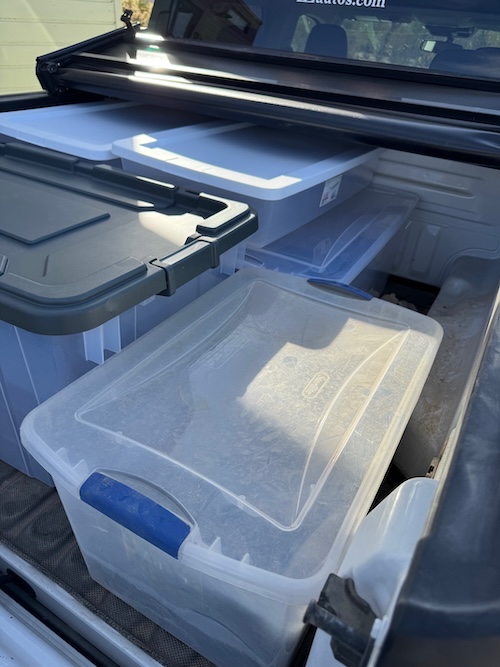
We repainted the exterior and peeled away the yellow tape still clinging to the trim from when the tiny house crossed the ocean. Sometimes we’d stop mid-task to admire the saguaro nearby, its crown in full bloom–a new flower each day. Lori sorted the plastic storage bins for travel while I rearranged the small shed on the south side, securing it with a key-lock box for whoever might need to work on the structure while we were gone. Above us, Neko observed it all from his favorite perch on the loft ladder, the quiet foreman of our leaving.
One morning, I drove to Starbucks to get out of the way while Lori finished the touch-ups. The barista asked what I had planned for the day. I said, “We’re getting ready to leave.” She smiled politely, not realizing that sentence carried a month of emotion.
There’s a strange rhythm to endings. You plan, you prepare, and then at some point, the planning becomes the point.
I caught myself opening the same “to-do” note three times one morning, not because I’d forgotten what was on it, but because it gave me the illusion of control. I could hold the list and feel productive. I could tell myself we were “getting things ready.”
But the truth is, no one’s ever ready. Not for endings, not for transitions, not for the quiet that follows both.
It reminds me of how we do meetings back home—every week, the same agenda, the same reports, the same call for updates. We tell ourselves the repetition builds consistency, but what it really builds is habit. Familiarity. The comfort of movement without much motion.
Persistence, though, is something else. It’s not efficiency; it’s endurance. It’s the willingness to show up, even when the plan doesn’t help anymore.
I’m good under pressure because the deadlines remove the illusion of choice. I stop tinkering and start finishing. But these past few days, there’s no hard deadline—just a slow fade of tasks and time. It’s teaching me a different kind of persistence: staying steady when the finish line isn’t visible.
Many evenings, I walk the same short loop behind the house.
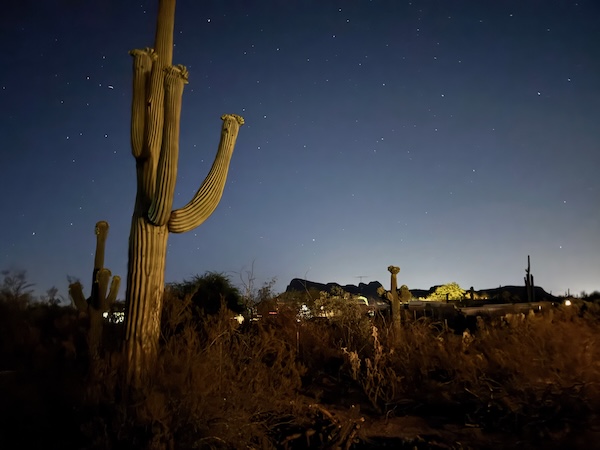
Past the wash. Past the saguaros. Past the spot where we watched the sunset our first week here, back when everything still felt wide open. The desert looks the same, but it feels different—less like arrival, more like memory.
That’s the real lesson of this place. You don’t conquer a desert; you coexist with it. It doesn’t reward completion. It rewards attention.
On our last night, we stood in the kitchen surrounded by packed boxes. As was the habit of when we moved to here, I jigsawed the boxes into the back of the Maverick, pulled over the bed cover, loaded the bikes on the back hitch carrier. We were ready for the trip back. I walked back inside to give the thumbs up that all was done and washed my hands.
I turned off the last light, opened the door, and looked out toward Panther Peak. The sky was the same pale blue it had been every morning since January. A few doves called from the fence line. Nothing dramatic, no swelling music, no clear line between staying and leaving.
Just a pause long enough to breathe in and say, we were here.
